
Nine in ten children in the world’s poorest countries reach age 10 unable to read a simple sentence.
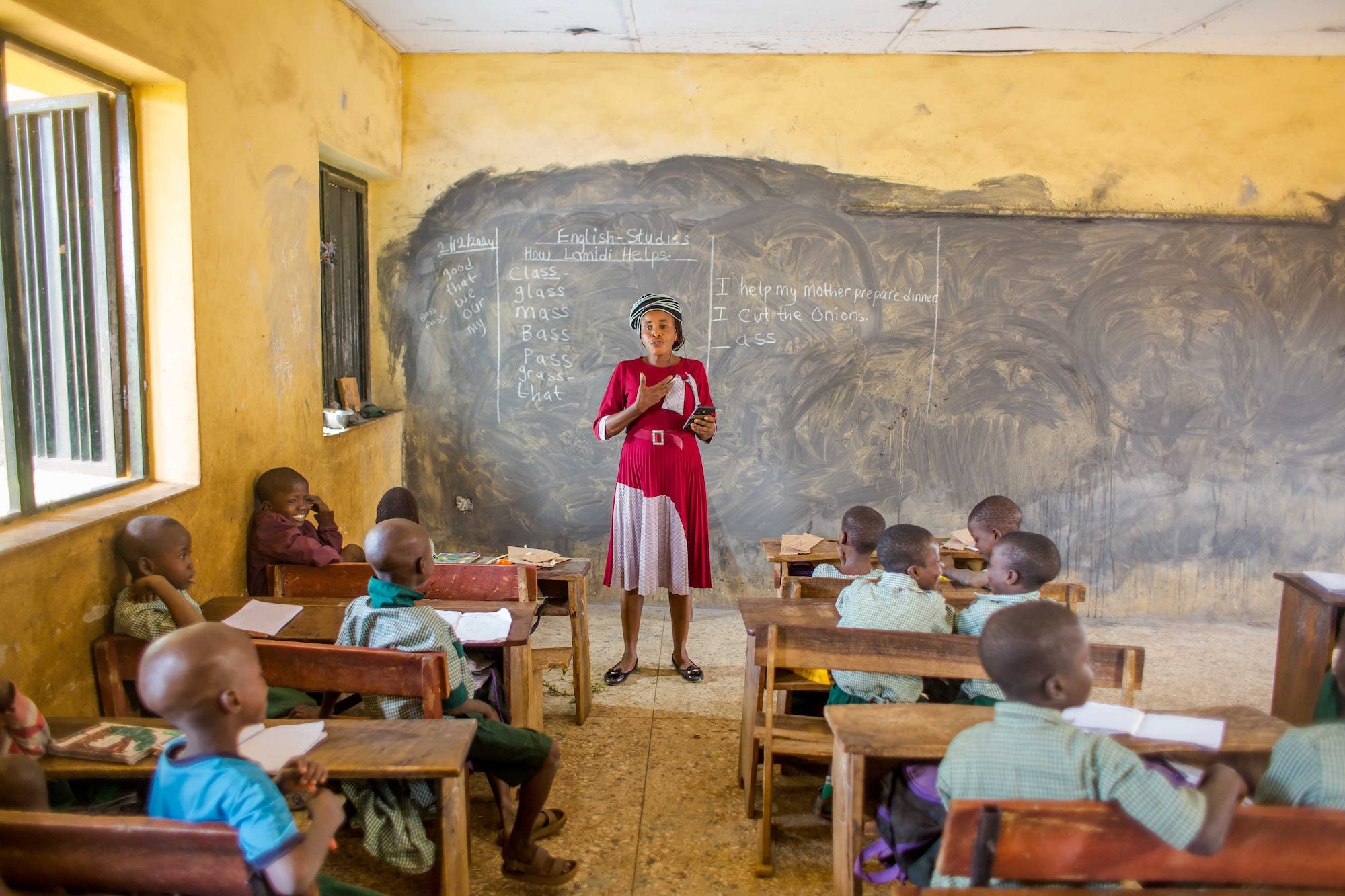
There is something surprising about this statistic. The problem is not that most of these children never enter a classroom. Between 2000 and 2015, developing countries made dramatic progress in primary enrolment. But learning outcomes improved far less. Attendance and learning had become separated. Now, in Sub-Saharan Africa, gross primary school enrolment is around 97%. But millions of children are attending school without acquiring the basic ability to read with comprehension or perform elementary mathematics. In many of the poorest countries, the main education problem now is that the classroom does not teach them enough.
So the central question is no longer simply: How do we get more children into school?
It is: How do we make sure that being in school actually results in learning?
That is the question at the heart of The Life You Can Save’s new Education Sector Report & Strategy 2026–2028. And one of the reasons I found the report encouraging is that, rather than merely documenting a huge problem, it identifies interventions that are already producing substantial learning gains, sometimes at remarkably low cost.
Unlike many enormous global problems, we have a surprisingly good idea of what can help.
This gap between attendance and actual skill is called learning poverty. The World Bank defines it as the share of 10-year-olds who cannot read and understand an age-appropriate text. By this measure, nine in ten children in low-income countries are learning-poor.
The report assesses education using the same three criteria The Life You Can Save applies across its work: scale, neglectedness, and solvability.
The scale is enormous. The problem is concentrated in some of the poorest parts of the world, especially Sub-Saharan Africa and South Asia. These two regions also account for 75% of the world’s out-of-school children. But, as we have seen, for most children affected by learning poverty, the central problem is not access to school. It is the quality of the education they receive once they are there.
The Consequences Go Far Beyond the Classroom
Each additional year of schooling is associated with an increase in earnings of around 9%. More strikingly, improving what children actually learn has been estimated to have nearly six times the effect on GDP of simply increasing enrolment.
The benefits extend to health as well. Across more than 50 low- and middle-income countries, maternal literacy has been associated with 37% fewer births per woman and a 67% reduction in child mortality.
Education is therefore not simply another cause alongside poverty reduction. Poor education is both a consequence of poverty and one of the mechanisms by which poverty persists across generations.
The Funding Does Not Match the Scale of the Problem
The annual financing gap for achieving the global Sustainable Development Goal on education in low- and lower-middle-income countries is estimated at A$147 billion. Sub-Saharan Africa alone accounts for about A$106 billion of that unmet need.
Low-income governments have very limited resources with which to close that gap. They spend, on average, just A$83 per school-age child each year. High-income countries spend approximately 155 times as much.
Global education aid is projected to fall by more than a quarter between 2023 and 2027. If announced aid cuts are fully implemented, UNICEF estimates that an additional six million children could be out of school by the end of 2026. At least 290 million children who remain enrolled could experience a decline in education quality as support for teacher training, learning assessment, curricula and other parts of education systems is reduced.
The countries facing some of the highest rates of learning poverty are often the countries losing substantial amounts of aid. In Chad, Mali, Niger and the Democratic Republic of Congo, learning poverty exceeds 90%. These are the countries that most need an increase in education assistance, yet current projections suggest that they will instead lose a substantial part of the assistance they are now receiving.
There is also a striking mismatch in where education funding goes.
Between 2020 and 2023, official development assistance provided A$30 billion for higher education, compared with A$12 billion for primary education. Philanthropic funding is similarly tilted towards universities and advanced study. By 2024, only 27% of education aid was going to basic education, and that proportion has been falling.
Higher education is valuable, but this allocation is difficult to justify if our aim is to direct limited resources where they can do the most good.
The children experiencing the highest rates of learning poverty are overwhelmingly of primary-school age. If they do not acquire foundational literacy and numeracy, they are unlikely ever to reach university.
What Actually Helps Children Learn?
This is where the question of solvability becomes particularly important.
The research team compiling the report reviewed the evidence on education interventions and consulted 17 education specialists working closely with governments, researchers and funders across Sub-Saharan Africa.
The evidence review and the expert consultation converged on the same answer: some of the strongest opportunities lie in structured pedagogy, teaching children at their actual learning level, and sustained support for teachers.
Consider what happens when teaching is organised primarily around a child’s age or school grade.
Children in the same classroom can be at very different levels. Some may be able to read a paragraph fluently. Others may still struggle to recognise words. Yet they are all expected to follow the same grade-level curriculum.
A child who falls behind can therefore continue moving through the school system while the material becomes increasingly difficult to understand.
Teaching at the Right Level, a nonprofit recommended by The Life You Can Save, takes a different approach. Children are assessed according to what they can actually do and instruction is adapted to their current level. Children can then be grouped for focused teaching rather than being taught material that assumes skills they have not yet acquired.
This approach has now been tested in eight randomised evaluations involving more than 75,000 learners across India and Sub-Saharan Africa. The studies found substantial learning gains, with much of the variation in results explained not by the country in which the program operated, but by how faithfully it was implemented.
Finding an intervention that works is not enough. It has to be implemented well.
The same lesson emerges from the evidence on structured pedagogy. This combines elements such as well-designed lesson plans and materials with training and continuing coaching for teachers.
A major review found that structured pedagogy produced some of the largest and most consistent improvements in learning of the education interventions studied.
Kenya provides an important example. Its government-delivered Tusome literacy program operated across roughly 23,000 public primary schools and increased the proportion of Grade 2 children reading at grade level by around 30 percentage points.
What is especially encouraging is the cost.
The most cost-effective interventions reviewed in the report can deliver more than two additional learning-adjusted years of schooling for every A$152 spent.
A “learning-adjusted year of schooling” attempts to measure something that ordinary enrollment statistics miss. A year in school in which a child learns very little should not be treated as equivalent to a year in which that child makes substantial educational progress.
Technology Is Not a Substitute
The report also contains an important lesson about teachers.
There is considerable interest at present in educational technology and artificial intelligence. These tools may prove valuable, particularly where teachers are scarce or children are difficult to reach.
But the evidence does not support the idea that technology alone will solve the learning crisis.
A review of 81 rigorously evaluated education-technology interventions found that simply providing greater access to technology without accompanying pedagogical support consistently failed to improve learning. By contrast, adaptive technology integrated into good teaching appears considerably more promising.
There are encouraging examples. EIDU, another one of The Life You Can Save’s recommended organisations, uses digital personalised learning integrated with classroom teaching. A randomised trial across 291 government pre-primary schools in Kenya found a significant improvement in learning over 13 months.
The Best Philanthropic Program Is Not Necessarily One That Remains Dependent on Philanthropy
Governments are ultimately responsible for education systems capable of reaching millions of children. Private donors cannot construct a parallel education system beside them.
The question is whether philanthropy can help governments make existing systems work better.
The experts consulted for the report strongly favoured programs that work through government systems, build local capacity and follow countries’ own education priorities rather than imposing an external agenda.
The aim should be for an effective intervention eventually to become something governments themselves can sustain, not something that disappears when a donor leaves.
That principle will shape The Life You Can Save’s education strategy over the next three years.
The organisation currently recommends seven education charities: Building Tomorrow, Educate Girls, EIDU, Food4Education, Luminos, Teaching at the Right Level Africa and Youth Impact. Most focus directly on foundational learning, and all work through or alongside government systems.
An intervention shown to work in a carefully controlled trial will not necessarily produce the same results when expanded to hundreds or thousands of schools. Teachers need to use it properly. Programs need to adapt to local circumstances without losing the features that made them effective. Governments need the capacity to continue them.
The Life You Can Save will therefore give greater weight to implementation quality, teacher support and whether organisations have a credible path towards eventual government-led delivery.
At the same time, the report identifies promising areas in which the evidence is not yet strong enough to justify the same level of confidence.
These include early childhood development, educational technology and AI, non-formal education for children outside the school system, and technical and vocational education for older young people.
Philanthropic money is comparatively flexible. It can support unusually effective programs, help establish whether they work, improve how they are implemented, and enable governments to adopt successful approaches at a scale private donors could never finance themselves.
A relatively small amount of money can therefore have effects far beyond the children directly reached by the original grant.
That is where philanthropy can be especially valuable by helping effective approaches prove themselves, improve, and reach the scale at which governments can carry them further.
A Broader Moral Point
Nine in ten children in the world’s poorest countries reaching age ten unable to read a simple sentence is not an inevitable consequence of poverty.
We know that teaching children at the level they have actually reached can work.
We know that structured teaching and sustained teacher coaching can work.
We know that some of these approaches can generate large improvements in learning at relatively low cost.
And we know that hundreds of millions of children are still not benefiting from them.
Once we know both the scale of the problem and that effective solutions exist, the question is no longer simply whether we should care about global education.
It is what we are prepared to do with the evidence we now have.
The full Education Sector Report & Strategy 2026–2028 goes much further into the data, the expert consultation, the interventions The Life You Can Save reviewed and the reasoning behind its priorities for the next three years. I encourage you to read it.
The report also informs The Life You Can Save’s Education Fund, which allocates donations across recommended education organisations according to the evidence and where current funding needs suggest they can have the greatest impact. If you want to help turn years spent in school into years of actual learning, I encourage you to support the Education Fund.
Im not even sure americans can read
Thank you Peter, I read this report when I saw it posted on LinkedIn. The report notes the sparseness of data about children with disabilities, which is quite right - but we (Chance for Childhood) are finding that this is more than an evidence gap, and is strongly linked to a lack of identification mechanisms.
When education systems cannot identify children with disabilities or additional learning needs, those children are easily missed in planning, funding and measures of progress (eg. official data in Ghana indicates 0.3% of children in school have a disability/special educational need, but in our screening and inclusive education projects, we find it is actually 13-16% - much more in line with the global average). We work across multiple countries and have some interesting data, evaluations and reports about this topic - happy to share if you'd be interested.